Showing posts with label Korean crafts. Show all posts

Sunday, March 13, 2016

Celebrating Korean Hanji paper in New York City with "Re:visioning Hanji"

It seems that Korean Hanji paper has been in the spotlight these last few weeks! After an interesting Festival held in Sydney, Australia, organized to celebrate and promote this amazing material, Hanji is once again the heart of a promotional event outside of Korea. Would 2016 be the Year of Hanji? I surely hope so!

This time, Hanji paper is the star of a special exhibition in New York City! Hanji artworks by contemporary artists Ran Hwang and Aimee Lee will be presented in "Re:visioning HANJI", from February 24, to March 31, 2016.

A special Hanji making seminar and hands-on workshop, led by Aimee Lee, is also organized on March 12 and 13 (Sat and Sun), to give visitors the occasion to experiment the paper-making process.

The exhibition is held in Gallery Korea at the Korean Cultural Center NY, at 460 Park Avenue (6th Floor) in New York City, NY, USA.

You can read the complete press release here: 
http://mb.cision.com/Main/13503/9902804/469801.pdf 

For more details, you can also refer to the Korean Cultural Center website :

 Hanji


Saturday, May 30, 2015

HanjiNaty at the 2015 Jeonju Hanji Culture Festival~!

The 2015 edition of the Jeonju Hanji Culture Festival was held in the beautiful city of Jeonju (Jeollabuk-do province) from May 2 to May 5 2015.

This year was the 19th edition of this event, and I was really looking forward to it, as last year's edition was cancelled (following the tragic accident of the Sewol ferry).

HanjiNaty was there for the 4-day event, with a booth in the market area. During the Festival, I had the occasion to meet some wonderful people, present my handmade creations to many visitors, and fraternize with my fellow Hanji artists and artisans.


New products in the HanjiNaty booth

In my booth I was offering to visitors a nice range of Hanji paper earrings, hair barrettes, and home decor items, including coasters, plates, tissue box covers and pen holders.

Handmade hair accessories, including headbands and barrettes,
were available for sale in the HanjiNaty booth.
Recently I have started to create new jewelry pieces, including brooches and necklaces. I have also added to my collection pony hair ties, that were quite popular!

Visitors seem to appreciate these latest additions, and it is giving me the desire to continue my exploration! I am planning on working on some leather bracelets with Hanji paper beads; I'll keep you posted with my progress, of course.


Meaningful encounters

One of the things I love the most about participating in festivals and craft shows is meeting customers, fellow artisans and visitors, and have the time to chat with them.

We made sure to place a sign in our booth that our visitors can expect to be served in English, Korean, French or German!

My husband and I put our linguistic skills to good use during the Festival, as we had the chance to meet visitors from France, Austria, North America, Australia, New Zealand, China, and of course, Korea.

People were generally very kind, and genuinely interested in my creative process. I had to answer the question "How did a foreigner end up doing Hanji crafts?" a few times; it is a fair inquiry, I believe I am the first Westerner to ever sell their own Hanji creations in the Jeonju Festival.


... The right site for the Festival?


This year, new brooches, pony tail ties, hair barrettes and
necklaces were available in the HanjiNaty booth.
This year the Festival site was once again set up around the Hanji Industry Support Center and the Traditional Cultural Center, a few blocks away from Jeonju City Hall. Despite the fact that these recently-erected buildings are very attractive, they remain fairly unknown to the general public.

Visitors and tourists are still naturally drawn to the Hanok Village, a popular traditional neighbourhood where you can find many art galleries, tea shops, tiny museums, etc., and where the Festival used to be held (until 2012), rather than the new Festival site.

I think the Festival is suffering from this lack of visibility, as the foot traffic wasn't as abundant as expected. I personally know several people who had difficulty finding the site, even when taking a taxi (many drivers didn't even seem to know where the Festival is located, which is quite troublesome).

It seems logical to have the Festival celebrating Hanji paper next to the Center dedicated to this sublime material, but we have to ask ourselves: is it the right location for a Festival that aims to attract large numbers of visitors? Is it the best way to host a successful event, that is appealing to the tourists, profitable for the vendors, and fruitful for the Hanji industry and community?

Odd configuration

Another thing that could be improved for the next edition of the Jeonju Hanji Festival is the configuration of the site.

This year, the Festival was spread on a wider radius, and the different zones (hands-on activities, Hanji market and stage area) were quite far from each other.

I think it would be beneficial to have the different zones closer to each other, and all grouped around the central stage area. In my opinion, it would keep the festive spirit up, and improve traffic to the different areas of the Festival, including the market, the shops inside the Cultural Center, the kids' zone, the National Contest Exhibit, as well as the hands-on activities. It would also encourage the vendors to keep their booths open later in the evenings, when the fashion shows attract visitors at night.

A great experience

Overall it was a great experience. I had a good time, met some fantastic people and did some good business. I was happy and proud to be participating in this event in Jeonju, the city where I discovered Hanji, and where I learned Hanji crafts. You can count on me for next year, especially knowing that 2016 will mark the 20th anniversary of the Jeonju Hanji Festival!


Thank you so much to my wonderful husband and partner.
Many thanks!

I want to take the time to warmly thank the people who helped and supported me throughout this adventure.

All my heartfelt gratitude to my extraordinary husband and partner, without whom I would have never succeeded the way I did.

I am also very grateful to all my friends (including my beloved Hanji teacher) who took the time to visit my booth during the Festival! I was also thrilled to see my Hanji friend Jan Coveney from Hanji Happenings, who visited Jeonju with her lovely sisters. It was wonderful to see you and feel your encouragement and support.

I want to especially thank my friend Byung Tae Goo for the beautiful photos you can see in this post.

See you all next year for the 20th Edition of the Jeonju Hanji Culture Festival !

Friday, August 23, 2013

Off the Walls!

HanjiNaty Korean Wall Organizer Handmade Craft ProjectFor the last few months, I have been working (on and off) on this imposing piece. For those of you wondering : it's a traditional Korean wall organizer - called a "go-bee" (고비) in Korean - originally designed to hold calligraphy paper, brushes and other documents.

The openings on the back were traditionally meant to welcome long rolls of calligraphy paper and the front boxes (that I like to call "balconies!") were designed to file letters and other paperwork.

In our modern days, very few of us need a wall-mounted cabinet to hold our calligraphy rolls and brushes... Nonetheless, it's still a gorgeous piece that I decided to "attack," after seeing a few stunning examples in Hanji exhibits and museums.

Additionally, with the constant and overwhelming clutter that takes over my house, why not give the old-fashioned scholar's organizer a try?

Where to begin?

The biggest challenge for me, for a piece like that, is where to begin. How to choose the right pattern? How to calculate accurately the dimensions of all the trim and designs I'll need to make this piece truly unique?  Most importantly, how not to get discouraged?

It took me a long time, and quite a few unfruitful attempts, to finally settle on a primary-colored theme, and traditional floral designs.


HanjiNaty Korean Wall Organizer Handmade Craft Project
The original pattern, found in
a Korean pattern book.
I decided to use the five traditional colors of Korean patterns : red, black, blue, yellow and white. Those five colors refer to the five directions (east, west, north, south and center), as well the five elements of classic Chinese philosophy.

I found in a Korean pattern book a design that piqued my interest; I decided to play with it, deconstruct it and use the different elements of the pattern on different parts of the wall organizer. 


HanjiNaty Korean Wall Organizer Handmade Craft Project
Each balcony displays this intricate flower pattern.
I was especially fond of the small flower designs (now that I think about it, don't they remind you of the fleur-de-lys, beloved symbol of Quebec?). I decided to cut dozens of those and place them on every shelf, as well as the corners of the front and interior panels.


HanjiNaty Korean Wall Organizer Handmade Craft ProjectI also separated the palm-like leaves from the central part of the design, and placed them on the sides of the three balconies.  You can only see them when you look at the wall organizer from an angle.


Take out your ruler!

This piece presented another big challenge for me. On top of being the largest item I had ever worked on, it also required very precise and accurate alignment during assembly.
HanjiNaty Korean Wall Organizer Handmade Craft ProjectHanjiNaty Korean Wall Organizer Handmade Craft Project

Usually, the objects I cover with Hanji paper are assembled prior to any application of the paper : I put the box or the pen holder together, and then I cover it with Hanji paper. In this case, I had covered all the different parts of the wall organizer before gluing them together.

When the time came to assemble the wall organizer, I had to measure precisely, in order to place the shelves and balconies correctly (Ah! That's why we have to learn math in school! ;)

Making sure that all the pieces were glued at perfect 90-degree angles was also essential...and not as easy at it seems! Also, when you work with instant setting glue, you don't have a second chance if you mess up the first time.

HanjiNaty Korean Wall Organizer Handmade Craft Project
Luckily, I was helped by my dear friends Mandy and Lee, who were wonderfully supportive throughout the whole process! With four hands, three rulers, a measuring tape, lots of patience and reminiscences of high-school math we were able to assemble it without any problems.


The final touch

HanjiNaty Korean Wall Organizer Handmade Craft ProjectThe last step of this project was to varnish the wall organizer. It took a surprising large amount of time to do it, but in the end the result is impressive.

HanjiNaty Korean Wall Organizer Handmade Craft Project
Now, this amazing piece is hung proudly in my house, ready to welcome documents, letters, pencils and pens, or whatever we feel like filling it up with...

Clutter has never looked so good!

Wednesday, July 3, 2013

"Teaching Hanji to Korean students?" Ya' right!

HanjiNaty Hanji Workshop with Korean students

A few weeks ago, I received a surprising message from one of my dear Korean friends. Being the manager of an English hagwon (학원, Korean academy where students study in the afternoon and evening), she was looking for a special activity for her middle-school kids. Something fun and hands-on, that would interest the students.

"Natalie, how about teaching Hanji to my Middle-school students?"

I almost chocked. 

Me? The foreign girl? Teaching a traditional ancestral Korean craft to... well... Korean students? 

It's like asking a South-African to teach Canadian kids how to tap maple syrup.

I wanted to scream : "You're kidding, right?"

Instead I said : "Sure."

And that's how it happened. How I ended up leading my very first Hanji workshop with a group of 11 Korean Middle-school students.

HanjiNaty Hanji Workshop with Korean studentsWhat to teach them? And how?

I won't lie: I was nervous. And concerned. What can I possibly teach them? How can I make this workshop interesting enough? Different enough? Exciting enough?.... What kind of item can we make that would be suitable for them? and for me?....

After thinking of different options (pencil cases? hand mirrors? pen holders?...) I decided to make clocks with my students. I wanted to give them a canvas that was easy enough to work with - no need to struggle with the tiny corners of a pencil case, or the unreachable bottom of a pen holder - but that was big enough that they would have leeway to imagine, design and create something that is truly their own.

HanjiNaty Hanji Workshop with Korean studentsThat was really the goal of this workshop for me : show the students that Hanji can be anything, take many forms and really allow them to be creative, free-spirited and imaginative.

My beloved husband (and helper for the workshop) had the brilliant idea to use Roman numerals on the clocks. It'd be a very interesting thing for the students to learn, and it would allow them a lot of creative freedom, using color strips of different lengths and widths.

I was expecting that many of them had already done Hanji crafts in the past (it's a popular activity for Elementary school students in Korea) so I wanted to offer them the option of creating something different. There will be no pre-cut patterns, no limits in the choice of colors or designs and no strict indications: I wanted to let their imagination run free, and really see what they could do.

Time to get our hands dirty!

At the beginning of the workshop, the students were very quiet. They were listening carefully to my explanations, but weren't very reactive. 

I told them a little about me, my discovery of Hanji and how it became such an important passion in my life. Afterwards I told them about the clocks we were going to make: I insisted on the fact that they are completely free to do it anyway they want, with the colors they want, without any limitations.

I told them : "You will not hear You can't do that! tonight. Anything is possible."

And they we began! The classroom quickly became this beautiful, colorful mess, full of paper strips, tubs of glue, giggling and laughter. 

HanjiNaty Hanji Workshop with Korean students11 students, 11 very different clocks

HanjiNaty Hanji Workshop with Korean students
HanjiNaty Hanji Workshop with Korean studentsAs soon as we began handling the Hanji paper, I quickly realized how different the students were from one another. Their generic look (same hair cuts, school uniforms, dark-rimmed glasses) might lead us to believe that they all think and create the same way, but we couldn't be further from the truth. 
HanjiNaty Hanji Workshop with Korean students

Each and every one of the students took a different and unique approach. I didn't have two students who chose the same color for the background of their clocks; they all took different paths to make their own design.

HanjiNaty Hanji Workshop with Korean students
Some students took a classic approach and made very symmetrical clocks: they used bold colors, striped patterns and geometrical patterns.

Some students were ripping paper with their hands, creating very organic clocks, with many different colors and fantastic textures.

HanjiNaty Hanji Workshop with Korean studentsHanjiNaty Hanji Workshop with Korean studentsSome students went even further and added origami flowers, faces, rabbit ears and moustaches to their clock.One student even put the name of her favorite K-Pop idol band B1A4 on her clock.

Some students even decided to use a black marker to write directly on the Hanji paper! My first reflex was to stop them from doing so, but then I remember my own rule, anything is possible!

It was wonderful to see how, with the same material and the same square canvas (and a limited amount of time) the students were able to create clocks that were so original and different from one another.


What does Hanji say about you?

Even if I don't know those students well (I was meeting them for the first time the night of the Hanji workshop), in a few hours I was able to learn quite a bit about their personalities, characters and interests by looking at their work and, more importantly, by looking at them work.

HanjiNaty Hanji Workshop with Korean studentsSome of them were concentrating on their task, working carefully and silently, with their faces very close to the paper. Some others were chit-chatting among themselves, reacting to each other's pattern and color selections. A few kids casually asked for my help or my advice, while some of their classmates politely declined my offers to assist them in their work.

HanjiNaty Hanji Workshop with Korean studentsWhile I was teaching them, I was constantly thinking of my own Hanji teacher, who has always given me room to explore, choose and create. I know my choices of colors or patterns have often surprised or puzzled her, but she's never tried to slow me down. She never imposed her vision of what Hanji is supposed to be. I did my very best to give the workshop students the same space and freedom to create, while not insisting on the technical aspects of Hanji; I assumed they can learn that later, if they develop a real interest for the craft.

* * *

I consider this very first Hanji workshop to be a success. The students seem to be very happy and proud of their creations, and so was I! I really hope to have the occasion to repeat the experience in the future, with those students or some other ones. I strongly believe that giving the students a chance to express their inner creativity (through arts and crafts, as well as music, writing, dance or any form of artistic expression) is essential to their growth, not only as students, but as human beings.

It was also important for me to show them that Hanji can be a modern craft, despite its traditional roots. It doesn't have to be conventional; it's a versatile and timeless medium that can be used in some many ways! I wanted to let them experiment and show them that arts and crafts don't have to come from a kit, and most importantly, don't necessarily have to follow a specific pattern. You just have to give it a try, let your imagination run free and allow yourself to be inspired by the material.

And if, as their Hanji instructor, I was able to make them see that there are no limits to what a person can do when he or she really wants to invest himself or herself into it, then I'd be the happiest Hanji-loving foreign gal on Earth!

HanjiNaty Hanji Workshop with Korean students
Natalie, the eleven Middle-school students and their gorgeous Hanji clocks.


Monday, May 13, 2013

The 17th Jeonju Hanji Culture Festival

I was very excited, as always, to go to the Hanji Festival this year. I've been there three or four times since I arrived in Korea. Along with three of my great girlfriends, I took the 9am bus to Jeonju, in order to enjoy a full day of creation, inspiration and... paper!

I had read on several websites that the Festival this year -- on top of having changed its name from "Hanji Paper Festival" to "Hanji Culture Festival" -- had also changed its location. The festival was no longer held in the gorgeous Hanok Village, but rather next to the Hanji Industry Support Center, a very nice center (dedicated exclusively to my beloved paper) built a few years ago.

When we arrived at the Jeonju bus terminal, we hopped in a cab. I was unable to get the taxi driver to understand me (even if I was reading, syllable per syllable, the name of the place we were aiming for) so we ended up in the Hanok Village. A quick visit to my Hanji teacher's workshop and we were back on the right track! We took a nice 10-block stroll on a nice sunny Saturday morning, until we reached the Festival.

Two new locations for the 2013 Festival 
HanjiNaty at the Hanji Culture Festival 2013 in Jeonju, South Korea
The new location of the Hanji Culture Festival, in Jeonju
We walked around the different sections of the festival : the information kiosk, outdoor stage, vendor booths, cultural booths (including a booth on Korean taekwondo, Hanji traditional clothing and the Chinese paper cutting art from the city of Soju), etc. There was also a bus stop to take us to Wanju-gun, the second area dedicated to the Festival. After asking to the welcome committee volunteers if a visit to Wanju-gun would be worth the while, we decided not to bother. Evidently we had to take a 30-minute bus ride to get to this second site, where the activities, attractions and booths were basically the same as the ones displayed in Jeonju.

Nice site, skimpy website
The volunteers who welcomed us at the entrance of the Festival were very kind, well informed and they spoke good English. They handed us the English version of the festival brochure, along with a map of the city. If the organization bothered to produce and print an English copy of their documents, why then isn't there an English version of the Festival website? A .pdf version of their English brochure available online would already be a nice start... Korea being one of the most wired and technologically inclined countries in the world, it still amazes me to see how skimpy the websites of major events can be, when they are not totally nonexistent for non-Korean speakers.
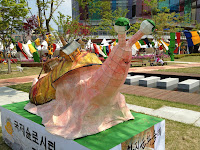
HanjiNaty at the Hanji Culture Festival 2013 in Jeonju, South Korea
Paper snail carrying a city on its back.
Cool symbol of Jeonju "slow city"!
HanjiNaty at the Hanji Culture Festival 2013 in Jeonju, South Korea
Hanji lanterns at the entrance
of the Festival site
Now, back to the Festival!
The new site was very nice; gorgeous paper lanterns were hung everywhere, as well as Hanji paper banners and flags. At the entrance of the Festival were hung dozens of beautiful white Hanji lanterns, and the Hanji paper snail, symbol of Jeonju "slow city," was there to welcome us as well.

This new location, between the Hanji Industry Support Center and the Jeonju Cultural Center, is an excellent choice. The site is vast and comfortable, less crowded than the Hanok Village and completely car-free, which is great. Unfortunately, it doesn't have the traditional vibe that offers the Hanok Village (with its beautiful houses, tea shops, tiny museums, fountains and sculptures) and it pulls the Festival away from the shop owners, artisans and artists that live and do business in the Hanok Village.

Meeting the Hanji people
HanjiNaty at the Hanji Culture Festival 2013 in Jeonju, South Korea
Coasters, Picture Frames and
Small Notebooks
Created by Goun Korean Paper
Handicraft Goundanji
We visited the few booths that were displaying the work of Hanji creators, and chatted briefly with a few of them. I was surprised to see that there were very few products for sale (mainly plates, tissues cases, coasters, hair pins and a few lamps) and that there was actually only one Hanji paper vendor! The booths were pretty quiet, and the Hanji artists weren't very voluble about their creations. Where is the enthusiasm? the passion? the excitement?.... Is it because we were four foreign gals, who made them feel uneasy?

HanjiNaty at the Hanji Culture Festival 2013 in Jeonju, South Korea
Hanji trays
Created by Koper
One of the reasons why I was so thrilled to go to the Festival this year was to meet "the Hanji people". Most of the time I do Hanji alone in my house, surrounded by mountains of paper and my three restless cats. Therefore, having the occasion to meet and discuss with other Hanji lovers was very appealing to me. Unfortunately, I have to admit that I wasn't able to make any real contact at the Festival.

Obviously, the first problem is always the language barrier; in Korea, it is constantly a problem. The presence of a "waygook-in" (외국인, Korean word that literally means "foreigner" and that is used to designated any non-Korean person) usually bring two types of opposite reactions: on one hand, Korean people will feel incredibly shy and will most likely walk away, hide or pretend they didn't see you; or, on the other hand, they will start to giggle (especially the younger ones), say "hello" way too many times and throw at you all the English sentences they have learned since Elementary school. As you can imagine, at the Hanji Festival we experienced both...
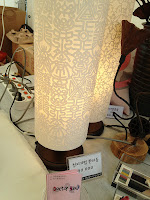
HanjiNaty at the Hanji Culture Festival 2013 in Jeonju, South Korea
Hanji lamps
Created by Doctor Hanji
I was especially surprised to see the young artists at the Doctor Hanji booth waving at me like kindergartners and repeating "hello! hello!" in a high pitch voice when I tried to engage in a conversation with them about their Hanji handicrafts. What is this about? Isn't the Festival supposed to be the occasion to promote your art and skills? Isn't it a wonderful platform to network, meet new people who share your passion, spread the word about your handicraft work and possibly extend your business or creative spectrum?... It seems that the Hanji artisans had a different vision than mine... Honestly, despite the fact that Doctor Hanji had stunning Hanji lamps for sale in their booth, I had no desire to purchase anything, nor to ask questions or try to establish a contact with these fellow craftsmen. I just felt annoyed and walked away.
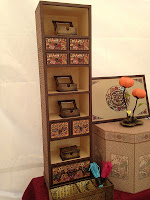
HanjiNaty at the Hanji Culture Festival 2013 in Jeonju, South Korea
Book case with drawers
Created by Ye-Dam

Even if I wasn't able to get into real interactions with the Hanji creators, I was still very  impressed with their craftsmanship. I was especially amazed with the work of the "Ye-Dam" team: their booth was filled with gorgeous pieces such as chests of drawers, book cases, tables, tea trays and lamps. Truly stunning work!

In the end, there were about half a dozen booths that were displaying Hanji creations at the Festival, which is too few, in my opinion. Is Hanji a dying art? Where are all the creators? Is having a booth at the Festival too expensive, or not beneficial enough? Or were they all in their own shop in the Hanok Village, instead of being on site at the Festival? It is surely a fair question to ask.

I have to admit that I am tempted to give it a try next year. Imagine that: a Hanji Naty booth at the Festival! A "waygook-in" with a booth at a traditional crafts Festival in Korea.... It could create a very interesting buzz, but it could also scare people away and leave me bitterly disappointed.... What do you think? Is it worth a try?

Get your hands dirty
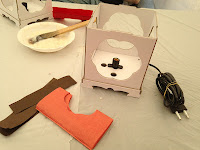
HanjiNaty at the Hanji Culture Festival 2013 in Jeonju, South Korea
At the Festival, we decided to make
Hanji square lanterns
One of the most interesting aspects of the Hanji Culture Festival is the hands-on projects. This year, the visitors had the chance to create many different types of objects, such as lamps, lamp shades, pencil cases, hand mirrors, fans, piggy banks, tissue cases, dolls, etc.

The hands-on section of the Festival was very well organized. The visitors were invited to go to the ticket booth, where you could choose the object you wished to create, and pay accordingly (for example, making a square lantern cost 11,000 won). Afterwards you just go to the designated tent, and you will be guided through the process by kind and friendly Festival staff.
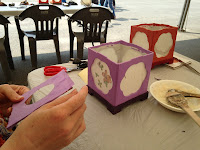
HanjiNaty at the Hanji Culture Festival 2013 in Jeonju, South Korea
11,000 won to make a square
Hanji lantern
My three girlfriends and I decided to make some square Hanji lanterns. No need to say that the presence of four Western girls at a traditional Korean crafts Festival drew a lot of attention; dozens of pictures of us doing Hanji must be circulating these days! We smiled a lot, got our hands all gooey with glue and paper fibers... we had an awesome time!

Doing a hands-on project at a Festival like that is usually a very smooth process: all the pieces are already cut and prepared for you, and you are walked through the process step by step. For someone like me, who's been doing Hanji for a couple of years now, it can also be a little frustrating. I kept looking for my tools on the table, my awesome pair of Japanese tweezers, my spatula, my favorite brush. Also, there isn't much room for creativity and freedom: the pieces are already cut, the colors chosen, the designs expected. It's like giving a coloring book to a painter; it's still a lot of fun, but it feels constraining.
HanjiNaty at the Hanji Culture Festival 2013 in Jeonju, South Korea
Dried flowers and leaves

Something especially interesting for me was the use of dried flowers and leaves; it's something I had seen done (usually on Hanji fans) but that I had never experienced. The delicate leaves and petals must be handled with much care; their colors and textures are truly wonderful.

HanjiNaty at the Hanji Culture Festival 2013 in Jeonju, South Korea
Olivia, Lee, Mandy and myself,
after completion of our hands-on project 
Making the whole lantern, from start to finish, took about an hour. We had a very good time doing it, and we are all enjoying this new handmade addition to our home decors. Hanji has this magical way to diffuse a warm and soothing light; believe me, there's nothing like it!


In a following blog post, all about the Exhibit of the Hanji Craft National Contest Winners 2013!


Links to the Hanji creators websites and blogs (in Korean only) :
Goun Korean Paper Handicraft
Koper
Ye-Dam Korean Paper Handicrafts (via Deokjin Self-Sufficiency Promotion Center)

Sunday, April 28, 2013

My Love Story with Hanji


Hanji Korean Paper
Korean Hanji paper
(c) visitkorea.or.kr
I've been living in South Korea for many years now. I have always been fascinated by the Korean traditional arts and crafts, especially embroidery and Hanji.

I live in Iksan, which is close to Jeonju, the Korean city for Hanji  That's in Jeonju that you will find the Hanji Museum, the Hanji center and that's where the Hanji Festival is held every May. Every time I would go to Jeonju I would spend lots of time in the tiny Hanji shops, literally drooling over the gorgeous plates, boxes and fans that the artisans would have for sale. I would constantly buy Hanji paper (the luxurious textures and colors and patterns were irresistible to me, and still are to this day), but would end up using it as wrapping paper, because I didn't know what else to do with this fantastic material. My friends back home were thrilled (they were sometimes more excited about the wrapping paper than the presents!...) but I felt that something was missing. I knew I had in my hands something extraordinary, but I didn't know what to do with it.

How old are you?

I asked a few Korean friends about 한지공예 (pronounced han-jee-gong-ye), trying to discover a place where I could learn the basics of this mysterious and fascinating craft. They all looked at me with that puzzled look on their faces: "well... there are workshops but they are for kids..." OK.... but how is that possible? The pieces I have seen in Jeonju (with the steep price tags attached to them) were surely not made by children; they were intricate, unbelievably detailed and obviously the result of dozens, if not hundred hours of work. Where could I learn? Who would teach me?

It took me more than four years to figure it out.

Blame it on the piggy
HanjiNaty Handmade Piggy Bank
One of the piggies I made,
with the pages of old English textbooks. 

And it all started with an arts & craft project I planned for my students at the English Academy I used to work. I decided to make piggy banks with my students, using a traditional paper mâché technique. I looked it up, mixed water and flour to make some gooey glue and we managed to create some cute piggy banks using balloons, newspaper and egg cartons. The results were surprisingly nice! The kids were thrilled, and so was the teacher.

That was in April 2011.

Afterwards I started to experiment with Hanji paper, to make a more refined and cool looking piggy. The Hanji paper was surprisingly difficult to tear into strips (that paper is tough, trust me) but when I managed to get it right the long and fibrous strips of paper were absolutely gorgeous.
Even if I enjoyed working with Hanji for paper mâché projects, I still hadn't found at that point a place or a person who would teach me what I really wanted to learn: the art of cutting and gluing the paper onto objects, like boxes or chests.

이미경쌤: A meeting that would change my life

Hanok Village in Jeonju
(c) visitkorea.or.kr
A month later, in May 2010, my husband and I decided to go to Jeonju for a walk on a cloudy Saturday afternoon. We spent time in the Hanok village (하녹마을, gorgeous neighborhood filled with traditional houses, art workshops, ceramics and hanji shops, tea houses and tiny museums), walking around and getting inspired by the great artistry we would see in workshops, boutiques and cafes. We made a mandatory stop in my favorite leather artist and shoemaker, and then moved along down the street.

We walked into this Hanji shop, about a block away from the main drag. This shop looked different; half of the space was used by Hanji items for sale (intricate lamps, hand-painted fans, boxes, coasters, dolls and decorative objects) and the second half was filled with tables and plastic stools, piles of cardboard and craft materials like brushes, scraps of paper, cardboard forms, blank fans and masks, etc. Imagine that shop as the collision point between an Elementary school art classroom and a high-end Hanji boutique.

Then, this Korean lady, with the sunniest smile I had seen in a long time, walked towards me. I liked her instantly. We started to chat, trying to meet somewhere between her limited English and my broken Korean; I asked her questions about the glue she uses to make her Hanji items, about the paper, the cardboard frames, the lamps. She answers me patiently, showing me things around her shop. Then I dared to ask: "Would you teach me?..." and, just like that, the response I'd been waiting for came: "Yes, or course! What do you want to make?".

I was so excited I could barely answer. I wanted to say "Everything!! I want to learn to make every single item sold in this shop!!" but I didn't want to scare her away! So we agreed on a tissue case; "Come next Saturday and I will teach you". Wow! Was it that simple all along? Was she there the whole time, just waiting for me to walk into her shop?....

No need to tell you that the following Saturday I was there. Excited and ready. Nervous and enthusiastic. That's when the Hanji Naty adventure truly began.